
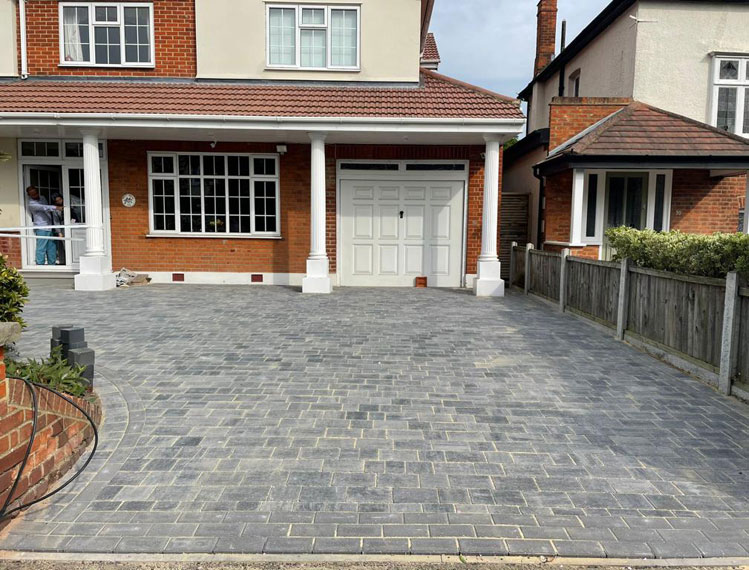
If you are planning new paving in Southend-on-Sea, whether for a driveway, patio, front garden or pathway, the choices you make now will determine how your outdoor space looks and performs for the next 20 to 30 years. Southend sits on London clay, close to the Thames Estuary, and that combination of heavy, moisture-retentive soil and salt-laden coastal air creates conditions that not every paving material handles equally well. Getting the right product, the right sub-base and the right drainage matters more here than in most inland towns.
This guide covers the main paving materials available for Southend-on-Sea properties in 2026, realistic costs per square metre, drainage requirements, planning rules, installation timelines, and what to look for when choosing a contractor. Whether you want a simple block-paved driveway or a full garden transformation with porcelain patio slabs and landscaping, the information here will help you make a confident decision before requesting quotes.
What Are the Most Popular Paving Options in Southend-on-Sea?
Homeowners across Southend and South Essex typically choose from five main paving types. Each suits different budgets, styles and practical requirements. Here is how they compare when used on properties in the Southend-on-Sea area.
Block Paving
Block paving remains the most popular choice for driveways and front gardens in Southend-on-Sea. Individual blocks, made from concrete or clay, are laid in interlocking patterns over a compacted sub-base. The main advantage of block paving is its flexibility. If a section sinks or a utility company needs access, individual blocks can be lifted and re-laid without replacing the entire surface. For Southend properties on clay subsoil, where minor ground movement is common, this is a genuine practical benefit.
Block paving is available in a wide range of colours, textures and patterns. Herringbone is the strongest pattern for driveways because the interlocking angles resist the lateral forces from vehicle tyres turning. Stretcher bond and basket weave work well for patios and paths where traffic loads are lighter. Leading manufacturers include Marshalls, Brett and Tobermore, all of which supply products suited to residential and commercial use across Essex.
Porcelain Paving
Porcelain patio slabs have become increasingly popular in Southend-on-Sea over the past few years. They are manufactured at high temperatures, which makes them extremely dense, low-porosity and virtually non-absorbent. This means they resist staining, algae growth and frost damage far better than natural stone. For Southend homes where north-facing patios stay damp through winter, porcelain’s resistance to biological growth is a practical advantage that reduces cleaning effort year after year.
Porcelain slabs come in a range of finishes that mimic natural stone, wood and concrete. They are thinner than natural stone (typically 20mm) and lighter, which can simplify handling on sites with restricted access. The main drawback is cost. Porcelain is more expensive than concrete slabs and requires a full mortar bed or pedestal system for installation, which adds to the labour element of the quote.
Natural Stone Paving
Indian sandstone, limestone and granite are the three natural stones most commonly used for patios and garden paths in the Southend area. Each has a distinct character. Indian sandstone offers warm tones and a slightly textured surface at a mid-range price point. Limestone gives a cleaner, more contemporary look but is softer and more susceptible to acid etching from bird droppings or spilled drinks. Granite is the hardest and most durable of the three but carries the highest material cost.
Natural stone is a strong choice for rear patios and garden entertaining areas where appearance is a priority. It is less commonly used for driveways because the slabs can crack under repeated vehicle loads unless laid on a reinforced concrete base, which adds significantly to the cost. For Southend’s coastal climate, Indian sandstone is the most forgiving option because it handles moisture well and develops an attractive weathered patina over time.
Resin Bound Paving
Resin bound surfacing mixes natural aggregate with a clear UV-stable resin and trowels it onto a prepared base to create a smooth, permeable finish. It is fully SuDS compliant because water drains straight through the surface, which makes it a strong option for front driveways in Southend where planning rules require permeable surfaces or adequate drainage to prevent runoff onto the public highway.
Resin bound driveways look clean and modern, they resist weeds and require very little maintenance. The surface is slip-resistant and wheelchair-friendly. The main limitation is that resin bound surfacing must be applied to a solid, stable base, typically tarmac or concrete, so it is often used as a overlay rather than a standalone system. If your existing driveway base is sound, resin bound can be a cost-effective way to transform its appearance without full excavation.
Imprinted Concrete
Imprinted concrete, sometimes called pattern-imprinted or stamped concrete, is poured as a single slab and then stamped with a pattern while still wet. It can replicate the look of block paving, natural stone, cobbles or brick at a lower material cost. The surface is sealed to protect against weather and staining.
The main advantage of imprinted concrete is speed. A typical driveway can be completed in 2 to 3 days, compared to 4 to 7 days for block paving. The downside is that it is a rigid slab. If the ground moves, which it does on Southend’s clay subsoil, the concrete can crack. Repairs are also more difficult than with block paving because you cannot lift and replace individual sections. The sealant layer needs reapplying every 3 to 5 years to maintain its colour and protection, which is an ongoing maintenance cost that block paving and resin bound surfaces do not carry.
How Much Does Paving Cost in Southend-on-Sea in 2026?
Paving costs vary depending on the material, the size of the area, the condition of the existing ground, access to the site, and the amount of preparation work needed. Below are estimated 2026 costs per square metre for paving work in Southend-on-Sea and South Essex, including materials, labour and sub-base preparation.
| Paving Type | Cost Per Square Metre (Installed) | Typical Driveway (40 sqm) | Typical Patio (25 sqm) |
|---|---|---|---|
| Block paving (concrete) | £70 to £120 | £2,800 to £4,800 | £1,750 to £3,000 |
| Block paving (clay/premium) | £90 to £150 | £3,600 to £6,000 | £2,250 to £3,750 |
| Porcelain slabs | £80 to £140 | N/A (patios only) | £2,000 to £3,500 |
| Indian sandstone | £70 to £110 | N/A (patios only) | £1,750 to £2,750 |
| Resin bound | £60 to £100 | £2,400 to £4,000 | £1,500 to £2,500 |
| Imprinted concrete | £55 to £90 | £2,200 to £3,600 | £1,375 to £2,250 |
| Permeable block paving | £85 to £140 | £3,400 to £5,600 | £2,125 to £3,500 |
These are estimates based on typical South Essex pricing in late 2026. Your actual cost will depend on the ground conditions, whether existing surfaces need removing, skip hire, scaffolding or access issues, and the complexity of the design. Edging and kerbing typically add £20 to £45 per linear metre. Always request itemised written quotes from at least three local contractors and make sure excavation, sub-base, drainage, waste removal and any necessary repairs are included as separate line items so you can compare like for like.
Why Drainage Matters for Paving in Southend-on-Sea
Drainage is not an afterthought in Southend. It is one of the most important parts of any paving project. The town’s position on the Thames Estuary, combined with the London clay subsoil that sits beneath most of the borough, means water does not drain away quickly. Clay is almost impermeable, so rainfall that lands on a paved surface needs somewhere to go, or it pools, floods neighbouring properties, or runs off onto the public road.
Under current permitted development rules, if you are paving over more than five square metres of your front garden with a non-permeable material, you will need planning permission unless the surface drains to a permeable area within your own property. The simplest way to avoid this requirement is to use a permeable paving system, such as permeable block paving or resin bound surfacing, or to include a soakaway or rain garden within the design.
A good contractor will assess your site’s drainage during the initial survey and include a drainage plan in the quote. For Southend properties, this often means installing a linear channel drain at the boundary to catch runoff, connecting to the existing stormwater drain, or building in a soakaway. Skipping this step to save cost is a false economy. Poorly drained paving leads to standing water, frost heave in winter, and premature failure of the sub-base.
Do You Need Planning Permission for Paving in Southend?
Most residential paving work in Southend-on-Sea falls under permitted development rights, which means you do not need to apply for planning permission. This covers driveways, patios, paths and garden paving, provided certain conditions are met.
For front gardens and driveways, the key rule is the five-square-metre threshold mentioned above. If your new paved area exceeds five square metres and uses a non-permeable material, you need either to direct runoff to a lawn or border within your property, install a soakaway, or apply for planning permission. Using permeable paving avoids the issue entirely.
Rear patios generally do not require planning permission as long as they do not raise the ground level by more than 300mm above the original level, cover more than 50 per cent of the garden area, or sit within one metre of the boundary and rise above 300mm. For properties in conservation areas, such as parts of the Crowstone and Chelmsford Avenue areas, additional restrictions may apply. Southend-on-Sea is now a unitary authority, so planning enquiries go through Southend-on-Sea City Council’s planning team rather than an Essex county body. If you are unsure, a quick call to the council before work starts can save expensive problems later.
How Long Does a Paving Project Take?
The timeline for a paving project depends on the size of the area, the material chosen and the amount of preparation work involved. Here are typical timescales for residential paving projects in Southend-on-Sea.
A single-car driveway of around 20 to 30 square metres, laid in block paving, typically takes 3 to 5 working days. This includes excavation, sub-base preparation, edging, laying and jointing. A double driveway of 40 to 60 square metres takes 5 to 8 days. A rear patio of 20 to 30 square metres, using natural stone or porcelain, takes 4 to 6 days including any drainage work and pointing.
Larger projects that combine a driveway, patio and pathways, or that include steps, walls, fencing and planting, can take 2 to 4 weeks depending on the scope. Imprinted concrete is faster, with most driveways completed in 2 to 3 days, but the surface needs 48 to 72 hours of curing time before it can take vehicle traffic.
Weather affects scheduling. Block paving can be laid in light rain but not in heavy downpours. Resin bound surfacing and imprinted concrete both need dry conditions. For Southend-on-Sea, the best months to start a paving project are April through to October, when dry spells are more reliable and daylight hours are longer.
Comparing Paving Materials: Which One Suits Your Southend Property?
| Feature | Block Paving | Porcelain | Indian Sandstone | Resin Bound | Imprinted Concrete |
|---|---|---|---|---|---|
| Best for | Driveways, front gardens | Patios, entertaining areas | Patios, garden paths | Driveways, front gardens | Driveways, paths |
| Cost per sqm | £70 to £150 | £80 to £140 | £70 to £110 | £60 to £100 | £55 to £90 |
| Lifespan | 25 to 30 years | 25 to 30 years | 20 to 30 years | 15 to 25 years | 15 to 20 years |
| Maintenance | Low (occasional re-sanding) | Very low | Moderate (sealing recommended) | Very low | Moderate (reseal every 3 to 5 years) |
| Permeable option | Yes | No | No | Yes (inherently) | No |
| Repairability | Excellent (lift and relay) | Moderate (slabs can crack) | Moderate | Difficult (patch repairs) | Difficult (full slab) |
| Coastal suitability | Excellent | Excellent | Good | Good | Fair |
How to Maintain Your Paved Surfaces
Most modern paving materials require very little upkeep, but a small amount of regular care extends the life of your investment and keeps it looking its best.
For block paving, sweep the surface every few months to prevent organic debris building up in the joints. If weeds appear, remove them by hand or with a targeted weedkiller rather than a pressure washer, which can blast out the jointing sand and loosen blocks. Every 2 to 3 years, top up the kiln-dried sand in the joints and consider applying a sealant if you want to enhance the colour and reduce staining.
Porcelain slabs need only an occasional wash with warm water and a mild detergent. Their low porosity means dirt, moss and algae struggle to take hold. Avoid abrasive cleaners or wire brushes, which can scratch the surface finish.
Natural stone benefits from an annual clean with a stone-specific cleaner and a soft brush. Sealing Indian sandstone after installation helps prevent oil and food stains from penetrating the surface, which is worth doing if the patio sits near a barbecue or dining area.
Resin bound surfaces are self-draining and weed-resistant by design. A periodic rinse with a hose and a gentle scrub is usually all that is needed. For imprinted concrete, the maintenance cycle revolves around the sealant. Once the sealant starts to wear, usually after 3 to 5 years, the surface becomes vulnerable to water ingress, fading and flaking. Resealing promptly prevents these problems from developing into costly repairs.
What to Look for in a Paving Contractor in Southend-on-Sea
The quality of any paving project comes down to the contractor. Poor ground preparation, inadequate sub-base depth, incorrect falls for drainage, and sloppy finishing are all problems that appear within months but are expensive to fix after the fact. When comparing paving contractors in Southend-on-Sea, look for these indicators.
First, check that the company carries public liability insurance and can show proof. Ask whether they use manufacturer-approved products and whether their team has received product-specific training. A contractor who works with named brands like Marshalls, Brett or Tobermore and can confirm approved installer status gives you more confidence in the quality of the finished result.
Second, ask for references from recent local projects, ideally within Southend or the surrounding towns of Leigh on Sea, Rochford, Rayleigh and Hockley. A company that can point to finished work in your area demonstrates local experience and accountability.
Third, insist on a written, itemised quote. The quote should separate excavation, sub-base materials, paving materials, edging, drainage, labour and waste removal. A single lump-sum figure makes it impossible to tell what you are paying for and harder to compare quotes fairly. Be cautious of any contractor who quotes by phone or email without visiting the property first. A proper site survey is essential to assess ground conditions, measure accurately and identify potential issues like tree roots, buried services or access restrictions.
Why Tradeline Drives and Patios Is Southend’s Trusted Paving Choice
Tradeline Drives and Patios is an established Essex company offering professional paving services across Southend-on-Sea and the surrounding area. The team installs block paving, porcelain patios, natural stone, resin bound driveways, imprinted concrete and permeable paving systems for residential and commercial customers.
What sets Tradeline apart is the combination of local knowledge, thorough preparation and real guarantees. Every paving project comes with a 5-year installation guarantee and a 10-year product guarantee. The team handles everything from initial site survey through to excavation, sub-base preparation, drainage, paving, edging and final cleanup, so you deal with one company rather than coordinating between multiple trades.
Tradeline also offers a full range of complementary exterior services including driveways, patios, rendering, landscaping, fencing, decking and garden walls. If your paving project is part of a wider property upgrade, having one team manage the entire scope saves time, reduces cost and ensures a consistent finish across all the exterior work.
Ready to get started? Request a free, no-obligation paving quote from Tradeline Drives and Patios today.
Frequently Asked Questions
How much does paving cost in Southend-on-Sea?
Paving costs in Southend-on-Sea range from around 55 pounds per square metre for imprinted concrete to 150 pounds per square metre for premium clay block paving, fully installed. A typical single driveway of 40 square metres costs between 2,800 and 6,000 pounds depending on the material chosen. These estimates include excavation, sub-base, materials, labour and waste removal.
What is the best paving material for a Southend driveway?
Block paving is the most popular and practical choice for driveways in Southend-on-Sea. It handles the clay subsoil well because individual blocks flex with minor ground movement rather than cracking. Herringbone pattern block paving is the strongest option for driveways and is recommended by most manufacturers for areas that carry vehicle traffic.
Do I need planning permission to pave my front garden?
If you are paving more than five square metres of your front garden with a non-permeable material, you will need planning permission unless the water drains to a permeable area within your property. Using permeable block paving or resin bound surfacing avoids this requirement entirely. Rear patios generally do not need planning permission under standard permitted development rules.
How long does a block paving driveway last?
A well-installed block paving driveway typically lasts 25 to 30 years with minimal maintenance. The jointing sand may need topping up every 2 to 3 years, and occasional weed removal keeps the surface tidy. Block paving outlasts imprinted concrete, which has a typical lifespan of 15 to 20 years and needs resealing every 3 to 5 years.
Is permeable paving worth the extra cost?
Yes, particularly in Southend-on-Sea where the clay subsoil drains poorly. Permeable block paving costs around 85 to 140 pounds per square metre, compared to 70 to 120 for standard blocks. The extra cost is often offset by not needing a separate drainage system and by avoiding the planning permission requirement for front garden paving over five square metres.
How long does it take to pave a driveway?
A single-car block paving driveway of 20 to 30 square metres typically takes 3 to 5 working days. A double driveway of 40 to 60 square metres takes 5 to 8 days. Imprinted concrete is faster at 2 to 3 days but needs 48 to 72 hours of curing time before vehicles can use it. Weather delays can extend timelines during autumn and winter.
Can I pave over an existing driveway surface?
In some cases, yes. Resin bound surfacing can be applied over a sound existing tarmac or concrete base without full excavation, which reduces cost and waste. Block paving generally requires the old surface to be removed so that a proper sub-base can be installed at the correct depth. A contractor should assess your existing surface during the site survey and advise whether overlay or full replacement is the better option.
What is the difference between resin bound and resin bonded paving?
Resin bound paving mixes aggregate with resin before trowelling it onto the base, creating a smooth, permeable surface. Resin bonded paving spreads resin onto the base first and then scatters loose aggregate on top, creating a textured but non-permeable finish. Resin bound is the preferred option for driveways because it is SuDS compliant, more durable and easier to maintain.
How do I maintain block paving?
Sweep the surface every few months to prevent debris building up in the joints. Remove weeds by hand rather than using a pressure washer, which can displace jointing sand. Top up kiln-dried sand in the joints every 2 to 3 years. Applying a sealant is optional but helps enhance colour and resist oil stains, particularly near parking areas.
What should I look for in a paving contractor?
Check for public liability insurance, manufacturer-approved products, product-specific training, and a written guarantee covering both materials and workmanship. Ask to see recent local projects and request an itemised quote that separates excavation, sub-base, materials, edging, drainage, labour and waste removal. Avoid contractors who quote without visiting the property first.