
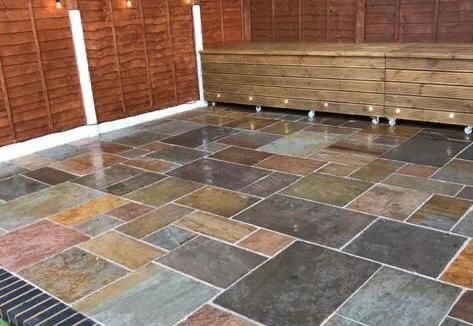
If you have started searching for porcelain patio installers in Hockley, you have probably noticed the same gap we did: most local pages list porcelain as one of several materials they fit, but very few explain what it actually costs, how it should be laid, or why it behaves differently to natural stone in an Essex garden. Tradeline Drives and Patios fits porcelain patios across Hockley, Rochford, Rayleigh, Hullbridge and the surrounding villages, and this guide sets out the detail other sites skip, so you can compare installers properly rather than picking the first name that appears.
What Porcelain Patio Installers in Hockley Should Actually Tell You
Porcelain is one of the most durable paving materials available, but it is also one of the least forgiving to lay badly. A good installer will explain three things before you commit: how they are preparing the sub-base, whether they are using a full mortar bed rather than spot bedding, and how they are cutting the slabs, since porcelain needs diamond-tipped equipment and a wet saw rather than a standard disc cutter. If a quote skips all three, the price may look attractive, but the finished patio is more likely to crack, lip or move within a few years.
Ask every installer on your shortlist the same three questions and compare the answers directly, rather than comparing the headline price alone.
Porcelain Patio Costs in Hockley in 2026
As a general guide for 2026, porcelain patios in and around Hockley typically cost £110 to £180 per square metre installed, with a mid-range project often landing around £140 per square metre once groundwork, a full mortar bed, edging and cutting are included. A modest 20 square metre patio therefore usually falls between £2,200 and £3,600 all in, though older gardens needing significant excavation, drainage or level changes can cost more. Porcelain generally sits a little above Indian sandstone on price, though the gap has narrowed in recent years as porcelain has become more widely available, and many installers now price the two closely depending on the specific range chosen.
Because every garden is different, we always provide a free, fixed written quote after a site visit rather than a price over the phone, broken down by groundwork, materials, labour and waste removal, so you can see exactly what you are paying for.
Porcelain or Indian Sandstone: Which Suits a Hockley Garden
Both materials do well locally, but they suit different priorities.
Porcelain is non-porous, which means it resists staining, does not absorb water, and will not grow algae or moss the way natural stone sometimes does in a shaded, damp Essex garden. It does not fade in sunlight, needs no sealing, and can last several decades when properly laid on a full mortar bed. Its main drawback is that it is a harder, more brittle material than concrete or sandstone, so it depends entirely on a well-prepared, fully supported base. A hollow spot under a slab that would simply settle with sandstone can crack a porcelain slab outright.
Indian sandstone has a warmer, more natural, slightly variable finish that many homeowners prefer on period properties, and it is more forgiving if the sub-base is slightly uneven. It is more porous, though, so it benefits from an occasional seal to resist staining, and it can weather and lighten over time in a way that porcelain does not.
Slip Resistance and Frost Performance for Coastal Essex Gardens
Hockley sits close enough to the Thames Estuary that gardens see higher humidity and more freeze-thaw cycling through winter than further inland, which makes slip resistance and frost performance genuinely practical concerns rather than marketing points. Textured and structured porcelain finishes carry a published slip rating (commonly R10 or R11 for external use) and keep their grip wet, unlike some polished natural stone finishes that become noticeably slippery in damp, shaded corners. Porcelain’s very low water absorption also means it does not take on moisture that then freezes and expands, which is the main cause of surface flaking seen on some poorer-quality natural stone after a hard winter. When comparing quotes, it is worth asking directly what slip rating the proposed porcelain carries, since not every installer specifies this unprompted.
Porcelain, Sandstone or Concrete Block: Compared at a Glance
Seeing the main patio materials side by side makes the trade-offs clearer than reading about them one at a time. The figures below reflect what we see on real jobs around Hockley, not supplier marketing claims.
| Material | Typical cost installed | Maintenance | Lifespan |
|---|---|---|---|
| Porcelain | £110 to £180 per m2 | None, no sealing needed | 25 years plus |
| Indian sandstone | £90 to £150 per m2 | Occasional sealing | 15 to 20 years |
| Concrete block paving | £70 to £120 per m2 | Occasional re-sanding, re-sealing | 15 to 20 years |
Concrete block paving remains the cheapest option and suits a more structured, formal patio design, but it does not match porcelain’s resistance to staining or fading, and most ranges need the joints re-sanded every few years. Sandstone sits between the two on price and offers a more traditional finish, but it is more porous than porcelain, so it benefits from a seal every two to three years to resist staining from garden furniture, barbecues and fallen leaves.
Design Styles and Finishes for a Hockley Patio
Large-format porcelain slabs, typically 600mm by 900mm or 800mm by 800mm, are the most requested format locally, since fewer joints give a cleaner, more contemporary look and make a smaller garden feel more spacious. Grey, graphite and warm stone-effect finishes are currently the most popular colours around Hockley and Rayleigh, chosen because they complement both render and brick and do not show dust or garden debris as readily as very pale tones. A textured, structured finish is worth specifying on any patio that gets shade for part of the day, since it keeps its grip far better than a smooth, polished finish once it is damp.
Many Hockley gardens now combine a porcelain dining or seating area with a step-down lawn or gravel border, using the patio as a defined outdoor room rather than paving the whole garden. Raised porcelain platforms with glass or slimline aluminium balustrades are increasingly requested where a garden slopes, since they preserve sightlines while still meeting the same groundwork standards as a ground-level patio.
Guarantees, Insurance and What to Check Before You Sign
A written quote is only half the picture. Before signing anything, it is worth confirming three further points that separate an established installer from a one-off trader working cash in hand. First, ask for proof of public liability insurance, ideally at least £2 million cover, since this protects you if something goes wrong on site during the build. Second, check whether the guarantee covers workmanship as well as materials, and get the length of each in writing rather than relying on a verbal figure given at the quote stage. Third, ask who will actually be on site carrying out the work, since some companies that advertise locally subcontract the physical build to a rotating team of tradespeople, which can mean less consistency and less accountability if a defect appears later.
None of this should feel like an interrogation. A contractor confident in their own standards will usually offer this information before you have to ask for it, and an installer who becomes vague or defensive when questioned on insurance or guarantees is worth treating with caution, whatever their quote looks like on paper.
How a Porcelain Patio Should Be Installed
A correctly installed porcelain patio in Hockley follows a consistent sequence, and knowing it helps you judge whether a quote is cutting corners. The ground is excavated to the correct depth and a compacted sub-base of MOT Type 1 is laid and levelled with proper falls for drainage, typically a 1 in 60 to 1 in 80 slope away from the house. A full wet mortar bed is then laid, never a thin screed or spot bedding, since porcelain needs complete, even support across the entire slab to avoid cracking under point load. Each slab is primed with a slurry coat before laying so the mortar bonds properly to the dense porcelain underside, a step some lower-cost installers skip to save time. Slabs are then laid to the chosen bond pattern, cut to size with a wet diamond saw around edges and obstacles, and pointed once the mortar has cured. A standard residential porcelain patio in Hockley typically takes three to six working days from groundwork to finished pointing, depending on size and access.
Do You Need Planning Permission for a Patio in Hockley
Most patios, including porcelain ones, fall under permitted development and do not need planning permission, provided the patio is not raised significantly above the surrounding ground level and does not sit forward of the principal elevation of the house in a way that affects the street scene. Where permission can come into play is drainage: since April 2008, any new hard surface over five square metres at the front of a house normally needs to use permeable paving, a soakaway, or direct drainage onto a lawn or border, unless planning permission is obtained for a non-permeable surface. Full detail is set out on the Planning Portal’s guidance on patios, paths and driveways, and if your property is listed or in a conservation area, Rochford District Council planning should be checked before work begins. We review this with every client as part of the quote, so drainage is designed in correctly from the start rather than queried after the event.
Why Tradeline Drives and Patios Is the Porcelain Patio Installer Hockley Homeowners Trust
Tradeline Drives and Patios is based nearby in Rochford and has fitted driveways, patios and porcelain paving across Hockley, Rayleigh, Rochford and the wider area for years, which means we know the local ground conditions and the drainage and planning points specific to this part of Essex. Every patio project carries a 5-year installation guarantee and a 10-year product guarantee, and we hold public liability insurance, details we are happy to put in writing rather than mention in passing. We provide a free, fixed, written quote after visiting your property, never a rough estimate over the phone, and our own team completes the work from groundwork to final pointing rather than subcontracting it out. You can see completed patio and driveway work in our project gallery, and porcelain patios sit alongside our decking and garden walls and steps services, so one team can manage a full garden project rather than you coordinating several different contractors.
Questions to Ask Before You Book a Porcelain Patio Installer
A short set of direct questions will tell you more about an installer’s standards than any amount of marketing copy. Ask to see recent, local project photos rather than stock images or supplier catalogue shots. Ask whether the quote is itemised by groundwork, materials, labour and waste removal, rather than a single total. Ask what slip rating the porcelain carries and whether it is fixed on a full mortar bed with slurry priming, since this is the detail that most separates a lasting patio from one that cracks within a few years. Confirm the guarantee length in writing, and check for public liability insurance before any work starts. A company registered with a recognised scheme such as TrustMark has also been independently checked against government-endorsed standards, which adds a further layer of reassurance when comparing unfamiliar names.
Get a Free Porcelain Patio Quote in Hockley
If you are ready to compare porcelain patio installers in Hockley properly rather than guessing from a list of names, call Tradeline Drives and Patios on 01702 668781 or freephone 0800 696 5803, message us on WhatsApp at 07853 202125, or use our contact page to arrange a free survey and fixed written quote. We also fit porcelain and natural stone patios across Rochford, Rayleigh, Hullbridge and the surrounding villages as part of our wider patio service.
Frequently Asked Questions
How much does a porcelain patio cost in Hockley?
Porcelain patios in Hockley typically cost £110 to £180 per square metre installed in 2026, with a mid-range project often around £140 per square metre once groundwork and cutting are included. A fixed price always follows a free site survey rather than a phone estimate.
Is porcelain better than Indian sandstone for a patio?
Porcelain generally performs better for low maintenance, since it resists staining, does not fade and needs no sealing, while Indian sandstone has a warmer natural look and is more forgiving of a slightly uneven sub-base. Both last well in Essex gardens when properly installed.
What slip rating should outdoor porcelain paving have?
Outdoor porcelain paving should carry a published slip rating of at least R10, with R11 recommended for shaded or frequently wet areas such as paths beside a house. Textured or structured finishes generally grip better than smooth, polished options.
Do you need planning permission for a patio in Hockley?
Most patios do not need planning permission, but any new hard surface over five square metres at the front of a house must use permeable paving or drain onto a lawn or border unless permission is obtained for a non-permeable surface. Listed buildings and conservation areas may have extra restrictions.
Why do porcelain patios crack?
Porcelain patios usually crack because of an incomplete or uneven mortar bed, missing slurry priming, or ground movement beneath a poorly compacted sub-base. Correct installation on a full wet mortar bed with proper priming largely prevents this.
Does porcelain paving need sealing?
No, porcelain paving is non-porous and does not need sealing, unlike natural stone such as Indian sandstone. This is one of the main reasons homeowners choose it for a low-maintenance patio.
How long does it take to install a porcelain patio?
A standard residential porcelain patio in Hockley typically takes three to six working days, from groundwork and sub-base preparation through to laying, cutting and pointing, depending on size and site access. We confirm a clear timeline in every written quote.
What thickness of porcelain is used for patios?
Outdoor porcelain paving is typically 20mm thick, sometimes described as a 2cm or paver-grade porcelain, which is thicker than the 10mm porcelain used indoors and designed to withstand foot traffic, weather and ground movement.
Can porcelain patios be laid over an existing patio?
It is sometimes possible on a solid, sound existing base, but most installers recommend removing the old surface and starting from a properly compacted sub-base, since laying over an uneven or failing patio risks the same cracking problems porcelain is prone to when poorly supported.
Which areas around Hockley do you cover?
We install porcelain and natural stone patios across Hockley, Rochford, Rayleigh, Hullbridge, Hawkwell and the surrounding villages. If you are just outside these areas, contact us to check coverage.